PrepTrack
A full-stack MERN placement preparation tracker that brings LeetCode logging, daily task management, goal tracking, study resources, and interview boards into one authenticated platform — built for students who grind.
01. The Problem
Students preparing for placements operate across an overwhelming number of tools simultaneously: LeetCode for problems, Notion for notes, Google Sheets for task tracking, random sticky notes for goals, and WhatsApp groups for resources. This context-switching leads to lost progress data, missed follow-ups, and zero visibility into overall placement readiness.
There was no single authenticated platform purpose-built for students to track everything — DSA grind, skill inventory, study materials, goals, and coding profiles — from one dashboard.
02. The Solution
I built PrepTrack — a full-stack MERN application with JWT-based authentication where every piece of preparation data is owned by the user and persisted in MongoDB. The frontend is a React + Vite SPA with Zustand for state management, and the backend is a Node.js + Express REST API with protected routes.
The app is structured as an npm workspaces monorepo where
both client/ and backend/ are managed from the project root, enabling a
single npm install to wire up all dependencies.
03. Tech Stack
- React + Vite: Fast HMR during development with a lean production bundle; React Router v6 handles client-side navigation across 8+ pages.
- Zustand: Lightweight global state management replacing Redux boilerplate — each module (tasks, goals, leetcode) has its own isolated store.
- Node.js + Express: RESTful API with 7 resource routers, all protected by a
custom JWT middleware that verifies the
Authorization: Bearerheader. - MongoDB + Mongoose: Flexible document schemas per module (Tasks, LeetCode entries, Goals, Skills, Resources, Profiles) all scoped to the authenticated user.
- JWT Authentication: Stateless auth — tokens are issued on login and verified server-side, enabling secure multi-device access without session storage.
- Tailwind CSS: Utility-first styling for rapid responsive UI iteration with a consistent design system.
04. Key Features
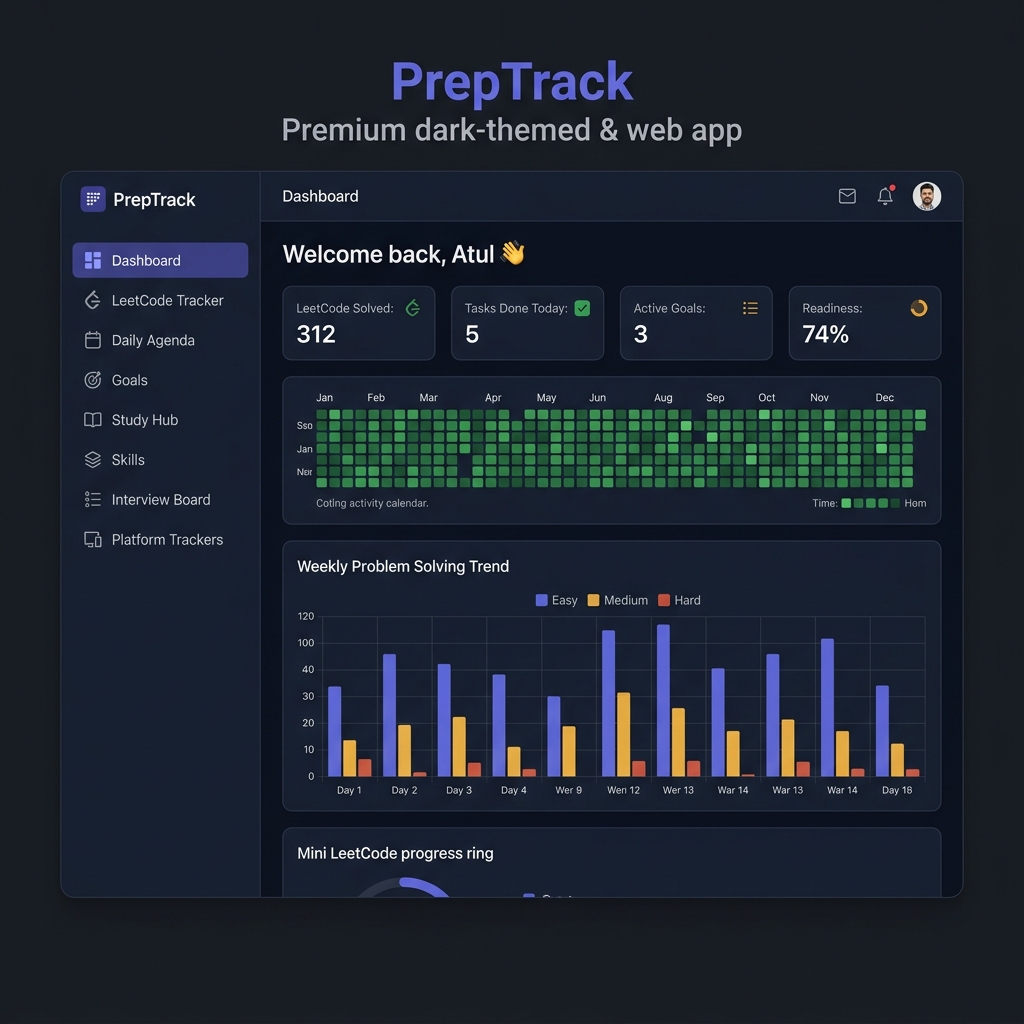
- Dashboard Overview: Central hub showing LeetCode problems solved by difficulty, active goals count, tasks completed today, a GitHub-style activity heatmap, and weekly problem-solving trend charts.
- LeetCode Tracker: Log each problem with title, difficulty, topic tag, and status (Solved / Revisit / Skip). Filter by difficulty or topic with visual progress bars.
- Daily Agenda: Task manager with due dates, one-click completion toggle, and a weekly overview to visualise productivity patterns.
- Goals Module: Set SMART goals with numeric targets and an animated circular readiness ring that fills as you progress.
- Study Hub: Organised repository of PDFs, external links, and notes categorised by DSA, Core CS (OS/CN/DBMS), HR prep, and System Design.
- Interview Board: Kanban-style board (Scheduled → In Progress → Done) to log mock interview details — company, round, date, and feedback notes.
- Platform Trackers: Save and quick-launch your profiles on LeetCode, GitHub, Codeforces, GeeksForGeeks, and HackerRank from one page.
05. Challenges & Learnings
Challenge: Managing Parallel Module State Without Redux
With 7+ independent data modules (tasks, goals, leetcode, skills…), a single Redux store would
have become a monolithic mess. Prop drilling was not an option either.
Solution: I adopted Zustand with one store per module. Each store co-locates its state, actions, and async API calls — making each feature independently testable and the codebase dramatically easier to navigate.
Challenge: JWT Token Expiry UX
When a JWT expired mid-session, users received cryptic 401 errors across every API call, breaking
the entire UI state simultaneously.
Solution: I added an Axios response interceptor that catches 401 errors
globally, clears the token from localStorage, and redirects the user to the login page
with a toast notification — gracefully handling session expiry without per-component error
handling.
Challenge: Activity Heatmap Performance
Rendering 365 daily squares with per-day color intensity from API data caused a noticeable render
lag on the dashboard.
Solution: I pre-aggregated the activity data server-side into a date-keyed map before
sending it to the frontend, and memoized the heatmap component with React.memo to
prevent unnecessary re-renders on unrelated state changes.
06. Impact
PrepTrack consolidates what previously required 4–5 separate tools into a single authenticated dashboard. The readiness score gives students a quantified, at-a-glance view of where they stand — replacing the anxiety of "I don't know how ready I am" with a concrete metric.
Building this project deepened my expertise in full-stack MERN architecture, JWT-based authentication flows, monorepo tooling with npm workspaces, and designing data schemas for multi-module applications.
npm install, add your MongoDB URI and you're running in under 2 minutes.